 NL
NL EN
EN
What is a Safari?
By Marion
I remember it clearly: 2006, my first trip to Africa, and my very first safari in Tanzania. Until that moment, a safari was just a word to me—something from documentaries and travel brochures. Beautiful pictures, far-off dreams. But the moment I drove through the gate of Lake Manyara National Park, I truly understood what a safari is.
As we entered the park, I felt that unmistakable Jurassic Park vibe: a car winding along twisty roads through dense greenery, expecting something amazing around every corner. No dinosaurs this time—just life. Everywhere. Zebras grazing by the road, giraffes towering above the trees, hippos lounging in the water, and alert antelopes watching us as we drove by. It was impressive, overwhelming even—but I knew this was just the beginning.
The Serengeti: the True “Wow” Moment
On day two, we drove from the cool Ngorongoro Highlands into the warm plains of the Serengeti. Only there did I truly feel how small we humans are. You know that feeling—the enormous wow that leaves you speechless. As the air grew warmer and the horizon opened up, everything changed. With each kilometer, the number of wildebeests increased. First a few, then dozens. Suddenly, countless numbers stretched as far as the eye could see.
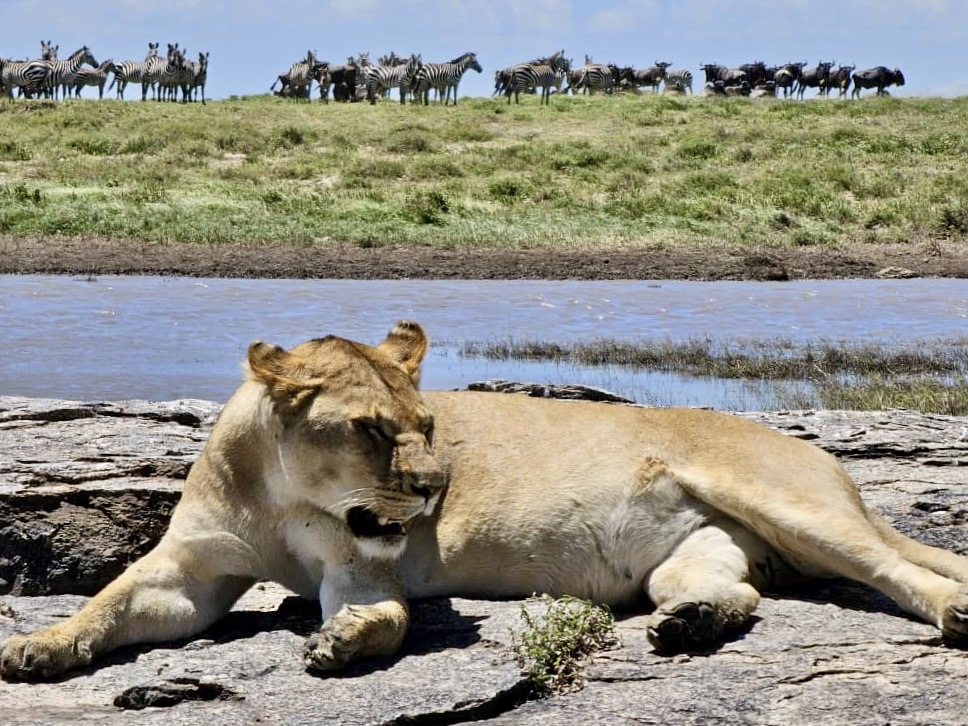
Just before the official Serengeti gate, two lionesses lay panting in the hot midday sun. Completely relaxed. A few zebras grazed calmly just ten meters away. No panic, no rush. Only pure balance. At that moment, I realized this was the Serengeti safari as it was meant to be experienced. Untouched, unplanned, and utterly real.
What is a Safari, Really?
In the Serengeti—and in all major parks—you truly feel how small we are and how breathtakingly beautiful the world can be. It’s not officially the Garden of Eden, but it certainly feels like it. Perhaps especially because you know that fossils and skeletons of the first humans were found here, like in Olduvai Gorge. That realization adds a layer to a safari that you cannot explain, only feel.
So, what is a safari really? For us at Caracal Tours & Safaris, it’s simple: an authentic Tanzania safari, immersing yourself in nature and feeling that overwhelming wow-moment. This is only possible if you’re willing to go off the beaten path sometimes. Excessive luxury is not a requirement. A comfortable, simple safari tent with a good bed is often enough. The fact that there is only canvas between you and the African wilderness at night makes the experience even more intense. You hear the sounds, feel the silence, and truly become part of the environment.
A Sustainable Safari Away from the Crowds
A safari is not “monkey-watching,” like in a zoo, or the way some large tour operators sometimes offer it. A sustainable safari in Tanzania requires more attention, more time, and sometimes a slightly higher budget—but certainly not a fortune. In return, you go deeper into nature, avoid the crowds, and experience Africa as it’s truly meant to be.
We also believe that Tanzania is not just about wild animals, but also about amazing people. That’s why we offer cultural experiences during a safari, respecting local traditions and customs. Most importantly, we ensure that the people living here also benefit from tourism.
We therefore prefer accommodations run by Tanzanian hosts, rather than large international hotel chains where most of the money leaves the country. This way, tourism has a positive, local impact.
No, I’m not Tanzanian myself. But I’ve lived and worked here for over 15 years. My life is here, my heart is here—and Tanzania feels like home. A safari away from the crowds is not just a product; it’s a way of seeing the world. A way I love to share with anyone open to wonder.
Some places are not just visited.
They stay with you forever.
